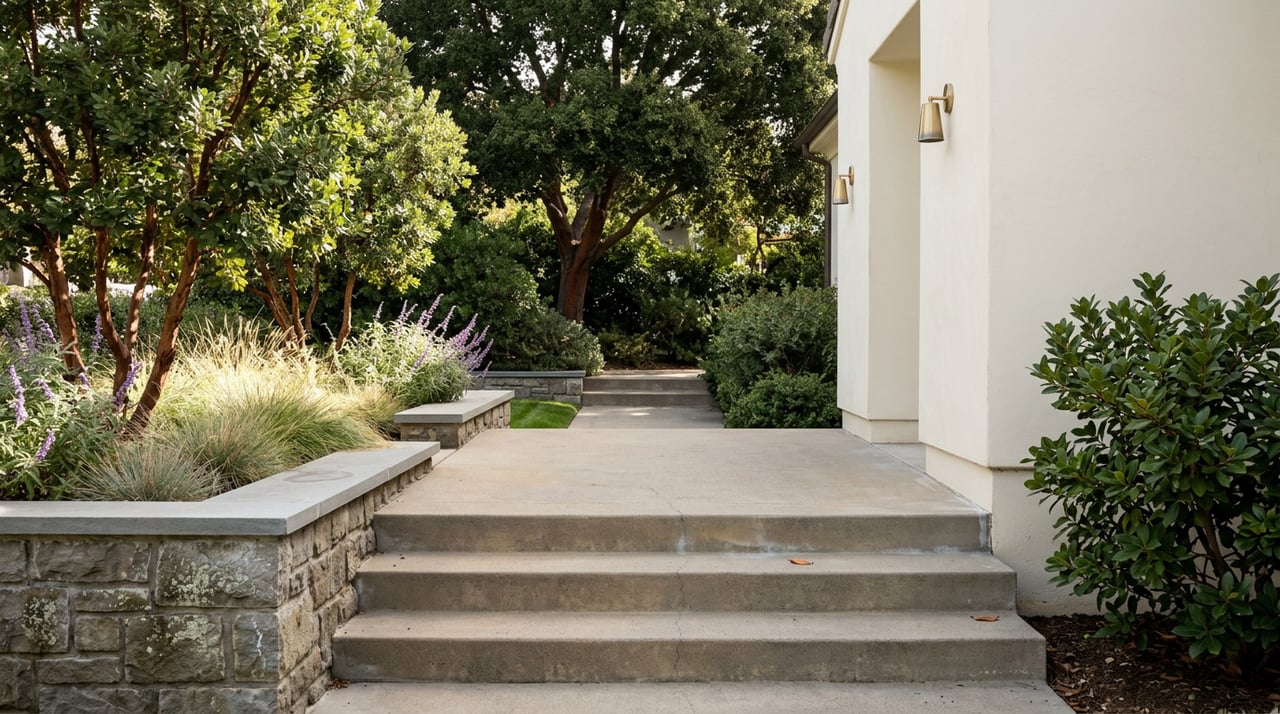
El Cerrito Hills vs Flats: What Home Prices Buy in 2026
July 23, 2026
July 23, 2026
El Cerrito is a 3.7 square mile city that trades as three different markets. The citywide median tells you almost nothing about which of the three you are buying into, and it is the reason so many buyers write offers that are either two hundred dollars per square foot too high or two hundred dollars per square foot too low.
The elevation change from San Pablo Avenue to the top of the Hillside Natural Area is about six hundred feet. That six hundred feet is doing more work in the offer file than any other single variable in the city.
Look at how the same city reads on the same day.
| Slice of El Cerrito | Recent median sale price | Median $/sqft | Days on market |
|---|---|---|---|
| El Cerrito Hills (3 months ending mid-2026) | ~$1.36M | ~$825 | 17 |
| El Cerrito citywide (three-month rolling, mid-2026) | ~$1.3M | ~$627 | ~20 |
| El Cerrito ZHVI typical value (April 2026 update) | ~$1.16M | — | — |
| El Cerrito North (trailing 12 months) | ~$1.25M, down about 17% year over year | — | — |
Two things jump out. The hills carry a price-per-square-foot premium of roughly thirty percent over the citywide figure, and they still clear the market in seventeen days while the city as a whole sits closer to three weeks. The hills are the fastest and most expensive foot of ground, but the North submarket, which includes a lot of the hills, is where the year-over-year correction has actually landed. A buyer who reads only the ZHVI drop of about eight percent over the past year assumes El Cerrito is a uniformly softer market. It is not. The flats have held better on percentage terms while the hills have taken a sharper correction from a higher base.
The mechanism that reconciles the two numbers is view, lot size, and the ceiling on what a hillside remodel actually returns.
Housing stock in El Cerrito is heavily concentrated in mid-century ranch, cape, and bungalow construction from the 1940s through the 1960s. Single family detached homes account for roughly two-thirds of the inventory. That vintage carries a predictable set of inspection findings that a buyer used to newer construction in Hercules or the Contra Costa 4 corridor will not have priced in.
The items that repeatedly come up in this housing stock:
None of this is unique to El Cerrito. What is local is how tightly it correlates with elevation. Flats built later on filled lots have their own drainage issues. Hillside homes built earlier on steeper grade have their own geotech problems. The inspection report is not a formality here. It is the second price negotiation.
Once you cross into the hillside zones, the buyer's file changes character. Wildfire exposure in the upper elevations is not theoretical, and carriers have been progressively tightening in Contra Costa County since 2023. A hillside home under contract in July can sit in escrow an extra ten days waiting on a bindable policy that a comparable flatland home would have secured in forty-eight hours.
Two related items catch buyers off guard:
"We had the offer accepted, the appraisal was fine, and we lost two weeks because the first three carriers wouldn't quote and the fourth wanted a defensible space inspection before they'd write it."
That is a common shape of the last mile in an El Cerrito hillside transaction in 2026. Geotechnical reports on steeper parcels are the second friction. Additions, ADUs, deck rebuilds, and retaining wall replacements on the steeper streets frequently require engineered drawings and a soils report before permits move, which changes what the same square footage is worth to a buyer planning to add on.
El Cerrito has two BART stations and they serve two different buyer pools. El Cerrito Plaza sits at the southern end and pulls demand from Albany, Kensington, and the northern edge of Berkeley. Del Norte sits at the northern end and functions as a regional bus hub with connections to several North Bay agencies. The catchments do not overlap much.
That matters for pricing in two ways. Flats within a ten-minute walk of Plaza compete against Albany inventory and get bid accordingly. Flats within a ten-minute walk of Del Norte compete against Richmond Annex and northern El Cerrito inventory and price differently. The Ohlone Greenway threading between them creates a narrow band where walkability, bike access, and station choice all compound, and that band is where the sale-to-list ratio has been most consistent.
The residential parking permit program around both stations is the item most often missed by buyers who assume BART proximity is a pure amenity. If you commute by train but keep two cars, the parking rules on your specific block become part of the monthly cost of the house.
Take three offers written on the same weekend at roughly the citywide median.
Flats, four blocks from Plaza BART. A 1948 two-bedroom, one-bath ranch of about 1,100 square feet on a 4,500 square foot lot. Original hardwood under carpet. A permitted rear addition from 1978. Sale-to-list at or above 100 percent, twelve days on market, six offers. The buyer's leverage is in the inspection contingency, not the price.
North side, walking distance to Del Norte and the Ohlone Greenway. A 1955 three-bedroom, two-bath of about 1,400 square feet on a 5,500 square foot lot. Detached garage with permit history that supports future ADU conversion. Fewer offers, longer days on market, but the ADU-potential language in the listing is doing real work in the price.
Hillside, off Arlington or near Tassajara Park. A 1952 two-bedroom, one-bath of about 1,050 square feet on a 6,000 square foot lot with a Bay view and a steep downhill drop. Same headline price, forty percent less interior square footage, higher price per square foot, and an insurance file that will take longer to close. The buyer is paying for the view and the lot, not the house.
Same money. Three different transactions. Anyone underwriting to the citywide median without picking a slice first is going to write the wrong offer in at least two of the three.
Are the hills actually cheaper right now because of the year-over-year drop? On a percentage basis, yes. On an absolute basis, the hills still sit above the citywide median on price per square foot. The correction from a high base is not the same thing as a bargain. It is a better entry than 2022 for the same lot, not a discount to the flats.
How much does the wildfire zone actually change what I pay? The headline premium is one number. The friction of finding a carrier who will bind on your closing timeline is the more expensive item, because a delayed close can cost the rate lock. Start the insurance quotes the same day the offer is accepted, not after inspections.
Is ADU potential real in El Cerrito or is it a listing agent talking point? It is real in the sense that state law supports it, and it is unevenly real in the sense that hillside geotech, existing unpermitted work, and utility hookup costs make some parcels much cheaper to convert than others. The permitted garage on a flat lot is the cleanest path. The tuck-under space on a steep hillside is the most expensive path even when the marketing copy is identical.
If you are comparing two El Cerrito homes at the same price and cannot articulate why one is priced per square foot and the other is priced per view, you have not finished the underwriting. Torretta Homes has been closing transactions across West Contra Costa County for close to forty years, and this is the work we do before an offer goes in. Get a Free Home Valuation or a buyer strategy session, and we will walk your target slice of El Cerrito with you before the next open house.
Stay up to date on the latest real estate trends.
We pride ourselves in providing personalized solutions that bring our clients closer to their dream properties and enhance their long-term wealth. Contact us today to find out how we can be of assistance to you!